Showing posts with label Summer arrangements. Show all posts

Thursday, January 19, 2017

SUNFLOWERS -- SUMMER BEAUTIES LOOK BEAUTIFUL IN ARRANGEMENTS


I don't grow sunflowers, but my neighbor does! I marvel at these tall beauties, and asked to cut some to make an arrangement.


She has several different varieties, all around 7-8 feet tall. Their nodding stems are a bit difficult to put in a basket container, so I used green plastic floral 'straws' to slide the stems in. This kept their heads up nicely.


The spent blooms are lovely in the arrangement as well. They add dimension and character to the bouquet.


The largest ones have big seeds. These can be harvested and roasted to eat.  


Sunflowers come in all sizes and colors. If you're interested in growing them, there are many fine nurseries and online stores where you can buy seed. Sunflowers love sun, and can grow in most any soil, as long as it's not soggy and wet.

I hope my neighbor plants them again this year--they were magnificent!

DINNER PLATE DAHLIAS -- THE MORE YOU CUT, THE MORE THEY BLOOM


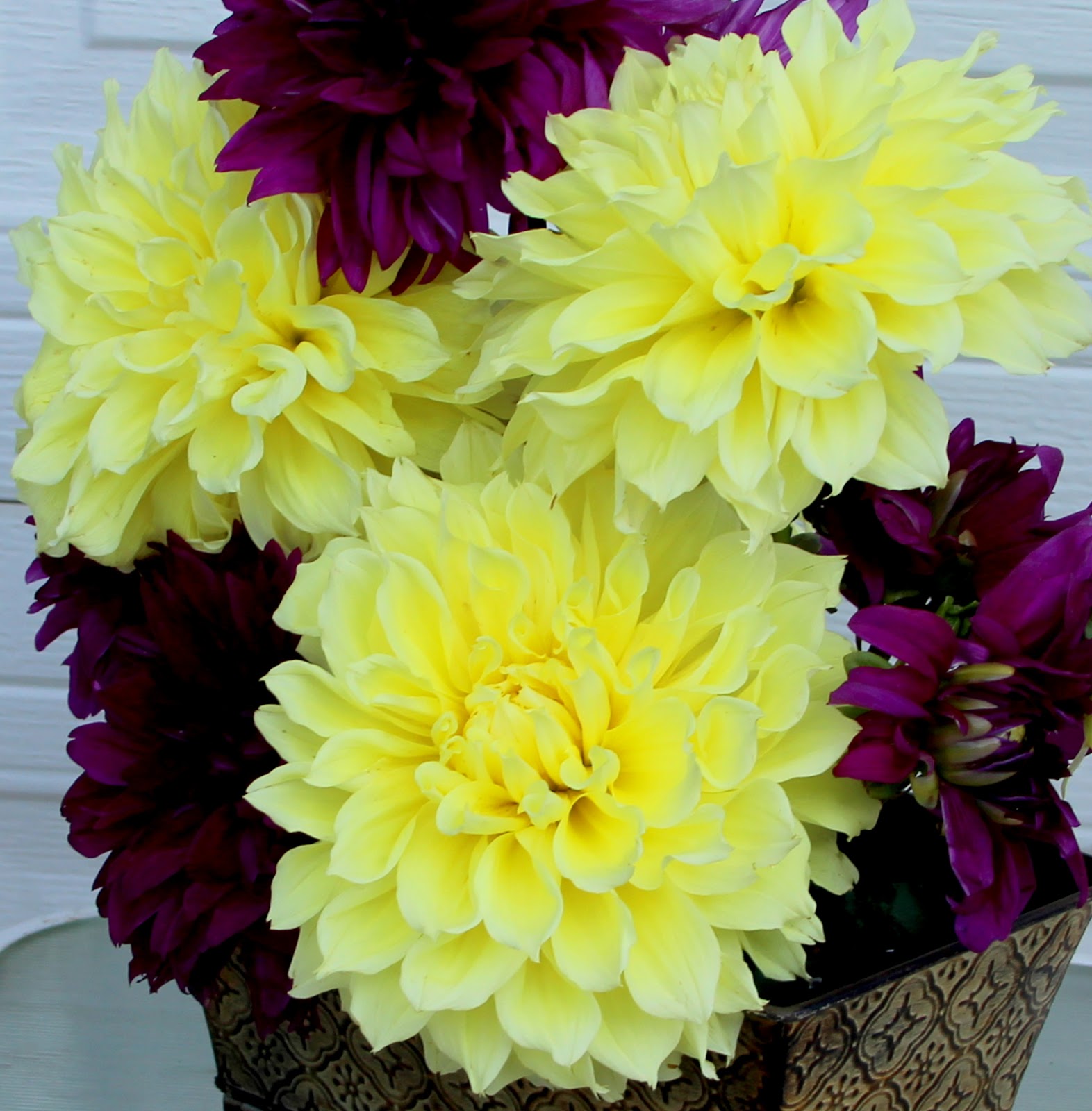
Beautiful dinner plate dahlia blooms of "Kidds Climax" and "Kelvin Floodlight" make a pleasing arrangement for the end of August. Kidds Climax, with its rosy raspberry bloom, is always perfect--and goes well with a myriad of other flowers. Paired with it, Kelvin Floodlight highlights the yellow at the center of the petals of Kidds Climax.


I love growing and arranging these majestic flowers. Even a single dahlia in a vase takes your breath away. Multiple blooms are a site to behold--lots of stares and comments because of their size and beauty. I highly recommend these beautiful flowers. In my zone, the tubers need to be lifted after the first killing frost. The tubers can then be stored until spring, to be planted out when all danger of frost has passed. Dinner plate dahlias are late bloomers, taking about 3 months from planting to harvesting, but well worth the wait.

DINNER PLATE DAHLIAS -- COMPLIMENTARY COLORS ADD DRAMA TO ARRANGEMENTS


Dinner plate dahlias are showy, easy-to-grow flowers that add drama and color to summer and fall arrangements. This end-of-August arrangement was at the starting of the peak season for the huge blooms.


Pictured here are sunny, huge "Kelvin Floodlight" dinner plate dahlias. They can be as much as 11" across.  This particular variety is especially prolific, having tons of blooms on a single plant all through the summer and into the fall.


Rosy purple "Thomas Edison" has lovely blooms measuring 9" across, and is another heavy bloomer. The more you cut, the more they bloom. I use them in arrangements all through late summer and into fall.


Cut when centers are still solid for best results.  Some people smash the stem ends with a hammer, or even sear the stems with a match. I really haven't noticed this helps with longevity in the arrangement.  I cut early in the morning,or at dusk. If cutting at dusk, place in luke warm water overnight, then cut off an extra inch, on the diagonal, to arrange. 

As always, keep out of direct sunlight and drafts when displaying your arrangement, and use a floral preservative in the water.

ROSES, ZINNIAS AND GLADIOLAS -- A COMPATIBLE MIX


Cheery blossoms of a mix of State Fair Zinnias in shades of pink and corals, with cool colors of gladiola and yellow Hybrid tea rose "New Day" make this compact arrangement a lasting bouquet.


These summer, sun-loving blooms require similar soil conditions, fertilizer and care. They will continue to bloom all summer and into the fall until a killing frost.


State Fair Zinnias usually come in a mix---the stalks will bloom in various colors from creamy white to dark red, with yellow, coral, several shades of pink, rose, and fuchsia.


Zinnias are annuals, but propagation is easy. Collect the tiny seeds after the flower has bloomed by taking a piece of paper and shaking the dried flower over it. Store seeds in a cool, dark place, then sprinkle in beds in spring when all chance of frost has passed. Thinning may be necessary. When plants are 2-4" tall, careful dig up with the root ball attached and plant where you want it. Or, nurseries have started plants that can be planted out as well. I've done both, and each is successful. 

WHITE FLORAL ARRANGEMENTS -- DEPTH AND BEAUTY WITH A MONOCHROMATIC THEME


Using only white flowers in this arrangement was very satisfying; I loved the results and plan on doing more in the future. It ended up being one of my favorites of the 2016 season.


6 different white flowers were used: Oriental lily "Casablanca," State Fair zinnia, hybrid tea rose "Pascali," "Purity" gladiola, "Esther Read" daisy, and to top it off, white lace cap hydrangea.


As always, cut stems early in the morning, use a floral preservative, and keep out of direct light and drafts when displaying them. 

GLADIOLA -- COLORFUL, EASY-TO-GROW SUMMER BLOOMS


Colorful blooms of gladiola in late July brighten up any day. I plant the corms usually in April, depending on the weather conditions that year.  (Although some are left in the ground through the winter, and they will grow and bloom first). I plant several corms every two weeks, insuring blooms all through the summer months and into fall.


I add some every year to the beds and thin the ones that have stayed in the ground through the winter months. Most that I have used are a mix of colors; I rarely get corms of all one color. I like planting them because they don't take up much room vertically--they're easy to 'tuck in' in areas that don't have much room. I use them where spring blooms are through blooming and a color spot is needed in the beds.


The tall 48-60" glads may need staking. I prefer planting the 36-48" varieties--they are easier to take take of in my garden beds. Plant in full sun in soil that will be moist, but not wet. When cutting for arrangements, since they bloom from the bottom to the top, make sure color is showing on the buds not in bloom. Always use a floral preservative, and keep out of direct sunlight for longer-lasting bouquets.

RED, WHITE AND BLUE ARRANGEMENTS -- HAPPY BIRTHDAY AMERICA!


Red hybrid tea rose "Abraham Lincoln," white daisy "Esther Read," and Asiatic lilies "Red Alert" and "Olina Eyemaster" and white "Royal Respect" with true blue bush delphinium make a colorful and patriotic arrangement for the 4th of July holiday.


Some years I didn't have white roses all month long, so I planted early blooming white Asiatic lilies. They, along with my favorite daisy, Esther Read, which was a transplant more than 40 years ago from my Grandmother's garden, always give me the white that I need. I've also used white clematis in years past--it just depends what is blooming the day I need them.


I snip off the stamens from the white lilies--this keeps the petals white (no falling pollen on them), and also increases their longevity in the arrangement.  However, in some arrangements, the stamens add some real beauty.


I'm always happy for July to roll around, and anxious to see what is blooming for the arrangement.

Thursday, September 17, 2015

COLORFUL SUMMER ARRANGEMENTS - Dinner plate dahlias, roses,

September 7th and the garden is colorful with dinner plate dahlias, hybrid tea roses and more gladiola and zinnias. The zinnias will bloom until a killing frost. Dinner plate dahlias, the giants in the garden, aren't hardy, and need to be pulled two weeks after a killing frost in the fall, when they have turned black. If necessary, carefully divide the 'fingers' of the tubers--sometimes there will be many--other times there won't be. Shake off the soil and let them dry for a few days before storing in a dry, dark place for the winter. Check on them periodically to make sure they aren't dry or molding. If dry, take a paper cup of water and put in the box with them.  If molding, brush off and make sure they aren't in a damp or humid area. Replant in the fall. Pictured here are three of my favorites: Pink, with a yellow heart "Kidd's Climax," white "Fleurel," and yellow "Kelvin Floodlight." 


Wednesday, September 16, 2015

ZINNIAS - State Fair variety are big and bold!

On August 31st there are lots of bright-colored, huge State Fair Zinnias blooming for the weekly flower arrangement.The blooms can reach 6-8" across, and are born on tall stems, some stalks reaching as tall as 5 feet, but the average height is about 3-4 feet. Some are singles, some semi-double, and others are fully double. There can even be each kind on 1 stem, as well. When purchasing, I get the State Fair mix, and so I don't know what colors will be blooming, but they are predominantly all shades of red, pink, orange, and yellow, with some white and coral. These annual flowers are easy to collect seed from. To collect, wait until flowers are spent and have gone to seed--you'll know because the blooms will be brown. I collect seed by shaking the dry, spent bloom onto a white piece of paper. The tiny seeds will fall out, and then I store the seeds in a labeled, legal-sized envelope in the refrigerator over the winter months until ready to sow in the spring.  You can plant indoors 6 weeks before time to set out in the spring. They are not true to the parent plant color--they will be variable.   


Tuesday, September 15, 2015

GLADIOLA - Luscious shades of shrimp for arranging

The weekly arrangement for August 23rd found these luscious shrimp-colored gladiola blooming in the garden. The top heavy 48-60" tall stalks are perfect for this 22" vase. Cut stems with some of the bottom flowers blooming, and others still in the bud stage for arrangements that will last over two weeks. If possible, keep cutting the stems shorter when the bottom blooms are spent. I did that to this one after picking it up from the dentist's office after a week, and enjoyed them for an additional week or so. I like to arrange in the evening, then put the arrangement in a refrigerator I have in the garage for flowers, set at 40 degrees, over night. I always use a floral preservative for extra long lasting displays.